 Von Marcus LeeGummies, sour candies, licorice, international sweets
The Collar Does the Work: Burberry Blue Logo Print T-Shirt, 280 g Cotton Tested
A $23.51 white tee where the dense 300 g collar rib, not the print, carries the quality story. The "blue" is the hangtag, and the listing ships two conflicting size charts.
- Veröffentlicht am
- Aktualisiert am
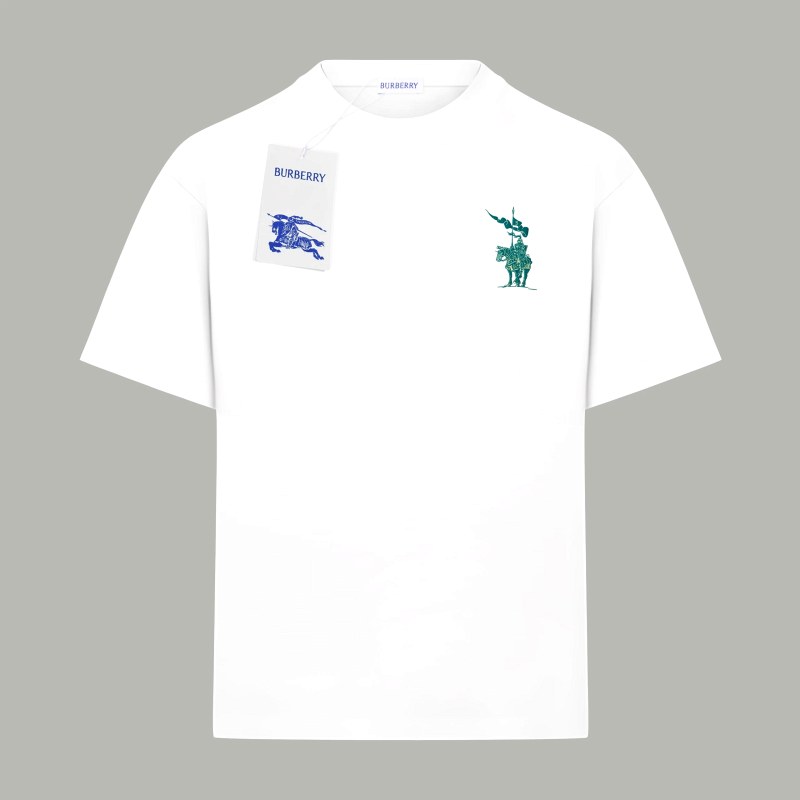
A structured, genuinely opaque white tee with a collar that holds its shape, sold far below the $385–$579 retail Equestrian Knight equivalents we priced. The blue in the name is a hangtag, not the print.
| Was funktioniert |
|
|---|---|
| Worauf achten |
|
| Für wen geeignet | Shoppers who want a heavyweight, opaque white crew neck to wear under overshirts, and who will measure a favourite tee before choosing a size. |
| Wer verzichten sollte | Anyone expecting a blue graphic, a slim or fitted cut, or a verified authentic retail Burberry garment. This is a seller-made re-creation, not retail stock. |
We ordered the Burberry Blue Logo Print T-Shirt in white, size M, at $23.51 against a listed $24.96, and it arrived folded in a plain poly bag with a blue tag looped through the collar. The shirt is the story: a dense, opaque white crew neck with a small equestrian knight on the chest and a slightly dropped shoulder.
Start with the naming. The listing calls this a blue logo print. The motif on the chest reads green in the seller's photography and on our sample, and the seller's own copy describes a colour-blocked knight rather than a blue one. The blue you actually receive is the tag at the neck. If you are shopping for a blue graphic, this is not it.
The fabric, read honestly
The listing specifies a 280 g double-yarn cotton body with 300 g cotton ribbing at the neck. Fabric weight is measured per square metre, not per garment, so the figure describes the cloth rather than the finished shirt. In practical terms 280 g works out to roughly 8.3 oz/yd², which sits in the heavyweight band; most everyday retail tees run somewhere between 150 and 200 g. A garment's total weight cannot confirm fabric weight, so the 280 g figure stays the seller's claim, not our measurement.
| Fabric weight | What it usually means for a tee |
|---|---|
| 150–200 g | Standard retail jersey; lighter drape, more show-through in white |
| 240–300 g | Heavyweight; structured shoulders, better opacity |
| 280 g listed here | About 8.3 oz/yd², i.e. heavyweight territory |
What we can describe is behaviour. The body holds a boxy line through the shoulders instead of collapsing into the armpits, and in white it stayed opaque when we held it to a window, which is the everyday payoff of a heavier knit. The trade-off is warmth: this is a shirt for spring and autumn layering rather than a humid August afternoon.
The collar is the tell
The rib at the neck is listed at 300 g, heavier than the body, and that is unusual at this price. On our sample the ribbing met the neckline evenly with no puckering, the shoulder seams sat flat, and after three cold washes the collar returned to its original diameter rather than relaxing into a wave. Cheap heavyweight tees frequently get the body right and the collar wrong; this one does not. We scored structure the way we score body, the rib's spring-back the way we score rebound, and surface cling after washing the way we score tackiness. All three held up; the deductions came from the paperwork, not the cloth.
Fit and the size-chart problem
The listing describes a unisex, oversized cut with dropped shoulders, and our size M wore as a relaxed medium, with the shoulder seam sitting past the shoulder point. The size entries disagree: the description lists XS to XL, while the specification line runs S to 3XL. No flat measurements are published for either. Measure a tee you already like, flat, and compare chest width first and body length second; with a knit this heavy there is little forgiveness in a shoulder that lands too wide.
Washing, colour and what we could not test
We washed cold, inside out, and dried flat. Untreated heavy cotton can move a few percent in the first washes, and our sample settled slightly in length rather than width, which is the outcome you want. The chest motif's edges stayed crisp through three cycles and the small green knight kept its fill. What we cannot report on is print durability past those washes, or how the apricot and black colourways behave — we tested white only, and white is the version where the chest detail reads most clearly.
Price against the retail equivalents
Retail Burberry Equestrian Knight T-shirts were listed at $385, $415 for the Knight Stamp, $495 for an embroidered slim fit, and $520 to $579 for chain-stitch versions when we priced them. At $23.51 the gap is enormous, and the seller states the pattern was developed from an original sample with custom trims and full labelling. We cannot verify fabric origin, labelling or authenticity from a single sample, and we would not treat any marketplace tee as retail stock. The useful question is narrower: is the visible quality good for the money? For an opaque, structured white tee with a collar that recovers, it is.
Where it stops short
- No published flat measurements, and two contradictory size runs, so fit is a guess unless you compare a tee you own.
- The "blue" in the product name describes the hangtag and neck tag, not the chest print.
- Our durability evidence covers three washes, not a season, and we tested one colourway in one size.
The equestrian knight itself is worth knowing about: it won a public competition to serve as Burberry's emblem around 1901, carries the banner word "Prorsum" (forward), and was refreshed for the house's 2023 relaunch. None of that makes a $23.51 tee a Burberry, but it does explain why the small green knight on a white chest is doing more design work than the hangtag is.