 By Clara WinslowChocolate, confectionery trends, sensory evaluation
Rolex Watch Shipping Cost Checks
The Task This Article Solves: Verifying Shipping Costs for Sending a Rolex Watch Overseas If you're preparing to ship a Rolex watch from China to overseas, what you really need to confirm isn't a single cheap-looking shipping quote, but whether that number matches the product, destination, packaging condition, chargeable weight, exchange rate, and tax/duty terms. Using the Black And Gold Two-Tone Datejust Watch scenario shown on the Fashionreps page, this article
- Published
- Updated
The Task This Article Solves: Verifying Shipping Costs for Sending a Rolex Watch Overseas
If you're preparing to ship a Rolex watch from China to overseas, what you really need to confirm isn't a single cheap-looking shipping quote, but whether that number matches the product, destination, packaging condition, chargeable weight, exchange rate, and tax/duty terms. Using the Black And Gold Two-Tone Datejust Watch scenario shown on the Fashionreps page, this article outlines a set of cost verification steps to follow before submitting your parcel.
This article was written on October 20, 2026. The current materials do not provide real-time product price, service fee, payment fee, packaging fee, route shipping cost, exchange rate, or destination country tax calculation results, so this article does not output specific unverified amounts. The product name, SKU, and QC page information from the page can only be used to confirm the verification subject, not to prove authenticity, brand authorization, inventory, or final shippability. ⌚️

First, Fix the Product Model, Destination, Quantity, and Current Page Evidence
The first step is to lock down the cost verification subject. Don't just record the general category "Rolex watch"; save the full model name, SKU, purchase quantity, destination country/region, and the shopping agent or shipping account you plan to use as shown on the product page.
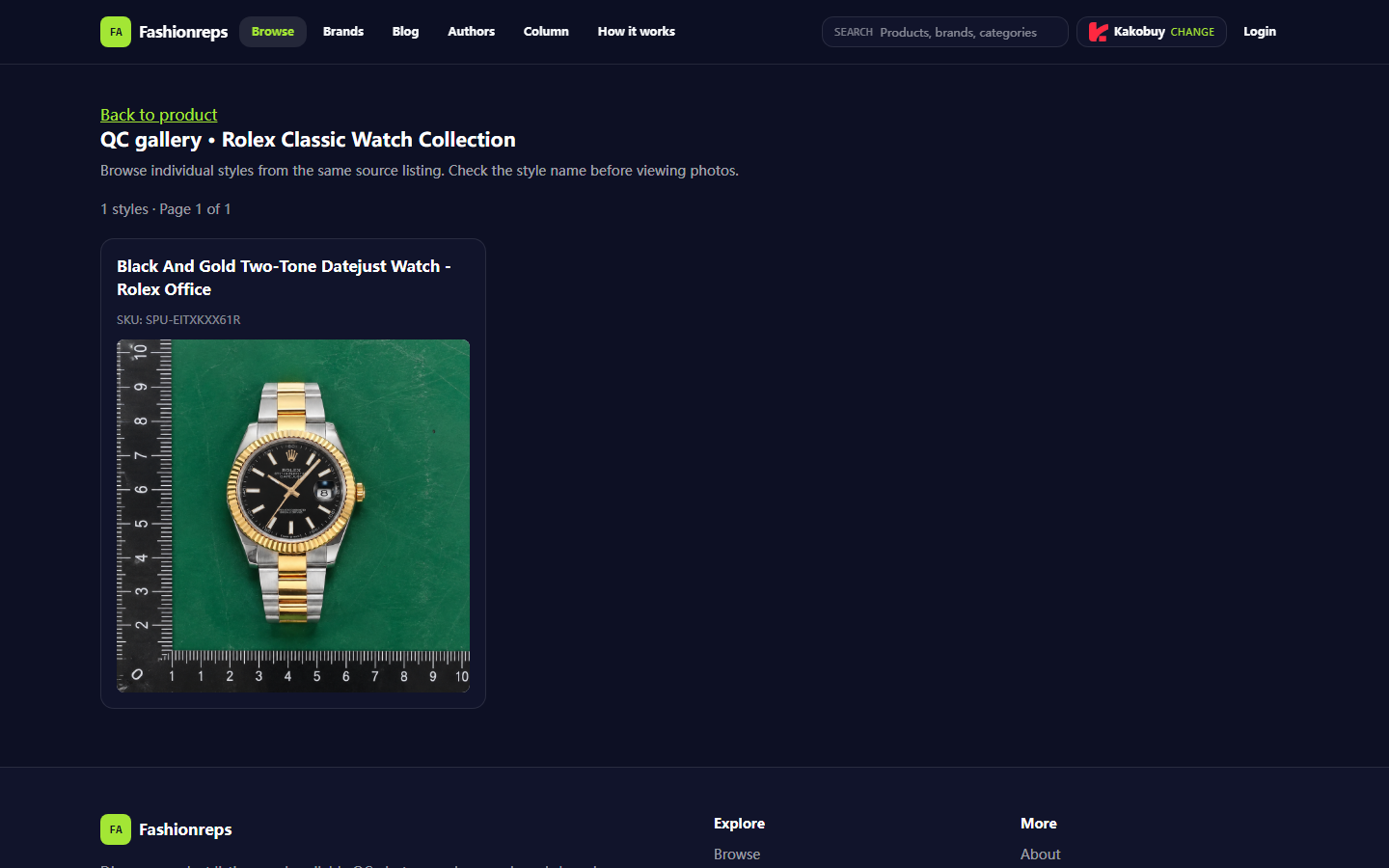
The sample page shows the product name as Black And Gold Two-Tone Datejust Watch, with SKU SPU-EITXKXX61F. This page is a Fashionreps QC page. The page description notes that you can view different styles from the same source product, and reminds you to confirm the model name before viewing photos. Since the currently visible materials only show one style, you should re-confirm that the product page has not changed in model, quantity, or status before verifying costs.
You should also save the following evidence:
- Product page screenshot or archive, including product name and SKU
- Destination country, city, or postal code, and recipient's region
- Planned number of parcels and whether combined with other items
- Agent platform or shopping agent name
- Packaging, QC, or warehouse status shown on the page
- Query time and currency used
If the destination or product model is not yet determined, you cannot treat any shipping quote as the final cost. 📦
Check Product Price, Service Fee, Payment Fee, and Exchange Rate Terms
The final cost should at least be broken down into independent parts: product price, shopping agent service fee, payment processing fee, warehousing or handling fee, packaging fee, international shipping, and possible taxes or destination processing fees.
Don't simply add an estimated shipping fee to the price on the product page and call it the total cost. Different platforms may use different pricing currencies, and may apply their own exchange rates or surcharges at the payment stage. You need to record separately:
- Displayed currency and product price on the page
- Actual settlement currency on your agent account
- Exchange rate or conversion method used on the payment page
- Whether there are service fees, payment fees, or fixed handling fees
- Whether fees are calculated per order, per parcel, or per item
- Applicable rules for refunds, cancellations, or exchange rate changes
If the page does not show real-time price, settlement currency, or fee breakdown, mark it as "not yet verified" rather than filling in a common market price on your own. Especially for branded items, the page name does not automatically prove authenticity, official source, or legal importability. 💱
Confirm Watch Packaging, Dimensions, Weight, and Billing Conditions
For watches, you typically need to verify the product itself, original packaging, protective materials, and outer shipping box. Whether the packaging is retained may affect actual weight, volume, and shipping risk; but do not remove packaging that protects the product or meets shipping requirements just to lower costs.
Before submitting the parcel, confirm with the warehouse or agent:
- What are the gross weight and chargeable weight?
- What are the outer box length, width, and height?
- Is billing based on actual weight or volumetric weight?
- What are the volumetric weight calculation rule and rounding rule?
- Are additional cushioning materials, watch boxes, or display boxes included?
- Does the packaging fall under fragile, valuable, or special handling categories?
- Do shipping restrictions apply to parcels containing batteries, metals, liquids, or other accessories?
If you only have the product name without measured weight and dimensions, you cannot calculate a reliable shipping cost. Do not treat the appearance size in product page images as dimension evidence, nor treat QC photos as weighing or packaging test records. 📏
Use the Official Shipping Calculator to Verify Route, Chargeable Weight, Transit Time, and Taxes
After obtaining warehouse measured data, use the official shipping calculator of the actual carrier, shopping agent, or route provider to get a quote. When querying, keep the following conditions consistent:
- Origin and destination
- Destination city or postal code
- Number of parcels
- Actual weight and volumetric weight
- Declared currency and declaration information
- Whether insurance or additional services are purchased
- Planned shipping route
- Query date and local time
The calculator result should be saved as a screenshot or export, and noted as a quote, estimate, or pre-settlement preview. Also check whether the result includes fuel surcharge, remote area fee, insurance, taxes, customs clearance service fee, and last-mile delivery fee.
If the calculator does not clearly state whether taxes are included, you cannot call the displayed amount a "tax-inclusive landed cost". The destination country may require truthful declaration of goods information, and may impose import duties, consumption taxes, customs clearance fees, or other charges according to local regulations. Do not try to reduce costs by under-declaring, splitting shipments to avoid taxes, or evading inspection. 🧾
Distinguish Real-Time Quotes, Page Rules, and Unverified Costs
Cost verification evidence can be divided into three categories:
First, real-time quotes—results generated by an official calculator after weight, dimensions, and destination are confirmed. Second, page rules—such as whether a route bills by volumetric weight or has remote area restrictions. Third, unverified items—such as final destination taxes, weight changes after warehouse repackaging, or fees that appear only at payment.
Only the first category can support a quote judgment under the corresponding conditions; the second category can explain the calculation method but cannot replace real-time amounts; the third category must be kept as a risk note and cannot be written into a confirmed total price.
For this Rolex watch sample, the current materials do not provide real-time calculator output, warehouse measured weight, outer box dimensions, destination, or settlement page, so only the cost item breakdown can be completed, not the final amount calculation. The Fashionreps page clearly states that purchase and shipping are handled by external shopping agent websites, and the page itself does not constitute an order, payment, or confirmation of international shipping. ⚠️
Stop Estimating When Data Is Missing or Conditions Change
If any of the following occurs, pause the estimate and gather the missing information:
- Product model or SKU does not match the item you intend to buy
- Destination country, city, or postal code is not determined
- Only product net weight is available, without parcel gross weight or dimensions
- Route name exists, but no corresponding official billing rules
- Calculator result has no query time
- Result does not state whether taxes, insurance, and surcharges are included
- Warehouse has not confirmed packaging method
- Page, calculator, or route status has changed
- Product may be subject to destination country import or brand-related restrictions
Pausing the estimate does not mean the order has failed; it avoids treating incomplete data as an executable quote. After the warehouse provides the latest weight and dimensions, you should re-query rather than reuse numbers from old screenshots.
Pre-Submission Checklist for Verifying Rolex Shipping Costs
Before submission, go through each item:
- [] Product name, model, SKU, and quantity have been verified
- [] Destination country, city, or postal code is fixed
- [] Product price, service fee, and payment fee are recorded separately
- [] Settlement currency, exchange rate source, and query time are recorded
- [] Warehouse has provided the latest gross weight and outer box dimensions
- [] Billing relationship between actual weight and volumetric weight is confirmed
- [] Official calculator shows the corresponding route and destination
- [] Transit time, insurance, surcharges, and customs clearance conditions are checked
- [] It is confirmed whether taxes are included in the quote
- [] No unverified numbers are written as the final total price
- [] No methods of under-declaring, splitting shipments to avoid taxes, or evading inspection are used
- [] All screenshots have covered order numbers, addresses, phone numbers, and payment information
With current evidence insufficient, it is impossible to prove that combining parcels is always cheaper. Combining parcels may reduce duplicate first-weight charges or fixed handling costs, but may also increase volumetric weight, declared value, and single-loss risk; splitting parcels may incur more fixed fees but may be suitable for route restrictions or reduce single-parcel risk. To determine savings, you need at least quotes for combined and split shipments under the same destination, same packaging standard, and same billing rules.
Therefore, this verification method is suitable for buyers who have determined the product and destination, can obtain warehouse measured data, and are willing to re-check official quotes before submission. It is not suitable for treating page display prices, old shipping screenshots, or estimates without destination conditions as the final payable total. Currently, there is not enough data to calculate savings; the confirmable conclusion is that any savings must be evaluated together with packaging changes, chargeable weight, tax uncertainty, and single-loss risk. ✅