 By Clara WinslowChocolate, confectionery trends, sensory evaluation
Represent Jacket & Pants: Is Combined Packaging Worth It?
Fall/winter jackets and pants are often planned together on a shopping list, but "same order" doesn't equal "combined packaging is always cheaper." What you really need to compare is item price, available discounts, payment and service fees, packaging method, chargeable weight, volumetric weight, destination taxes, and exchange rates—all under the same query scope. 🧥👖📦 This article focuses on one specific task: after discovering [Represent](https://fashion-
- Published
- Updated
Fall/winter jackets and pants are often planned together on a shopping list, but "same order" doesn't equal "combined packaging is always cheaper." What you really need to compare is item price, available discounts, payment and service fees, packaging method, chargeable weight, volumetric weight, destination taxes, and exchange rates—all under the same query scope. 🧥👖📦
This article focuses on one specific task: after discovering Represent fall/winter jackets and pants on Fashionreps, how to decide whether the two items should be combined, shipped separately, or held off. The article does not guarantee the lowest price and does not turn estimates without current quotes into confirmed amounts.
Clarify the Cost Decision for Combining Represent Fall/Winter Jacket and Pants in One Order
First, turn the question into an actionable check: If the jacket and pants have confirmed styles, colors, and sizes, and you can get valid quotes for both packaging options, compare the total cost of combined shipping versus separate shipping. If the product page, warehouse rules, or shipping calculator lacks key data, stop calculating and request more information.
Combined packaging may reduce repeated fixed handling fees or initial weight charges, but it can also increase the package's chargeable weight, volumetric weight, single-package loss risk, or trigger route restrictions. Separate packaging may increase fixed fees but can lower declared value per package, resolve route restrictions, or make after-sales handling easier.
So the conclusion shouldn't be based only on "will shipping together save freight," but on the following total costs:
- Actual amount paid for the items
- Verifiable discounts or promotions
- Payment processing fees
- Shopping agent or warehouse service fees
- Packaging, reinforcement, or consolidation fees
- International shipping for combined or separate packages
- Destination taxes and customs clearance costs
- Exchange rate conversion differences
- Increased risk of loss, return, or after-sales issues from combined packaging
Record Style, Color, Size, Price, and Link Time from Fashionreps Product Pages
Fashionreps is designed to help users discover products, view sourcing guides and QC information, and then direct users to external shopping agents. Orders, payments, and logistics are handled by the chosen agent platform. Therefore, information on Fashionreps pages does not automatically replace the agent platform's current quotes, nor does it prove that the jacket or pants have available stock.
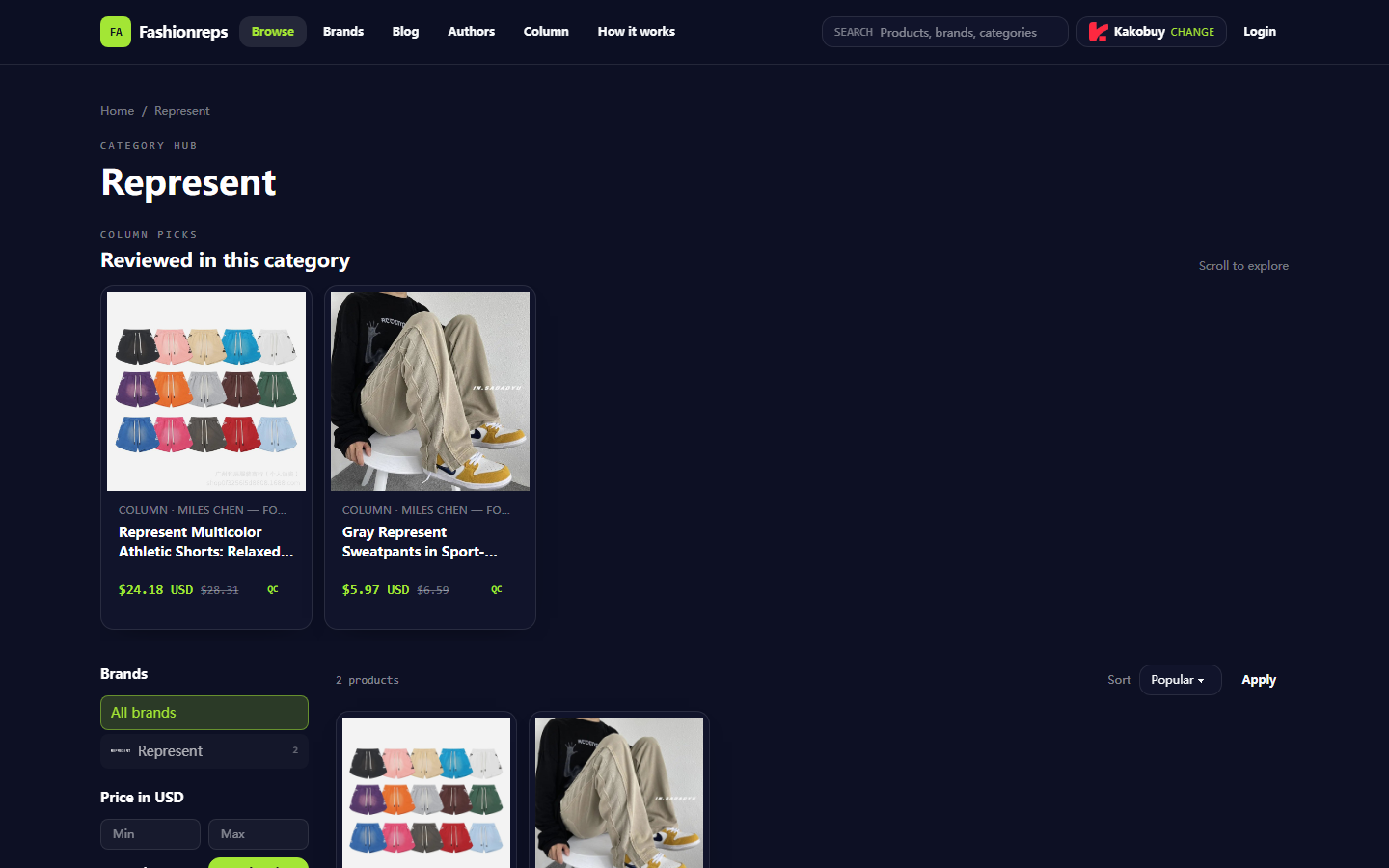
The provided materials include a screenshot of the Represent category page, but not complete product samples of the target fall/winter jacket and pants, current stock, available sizes, current item prices, or warehouse measured weights. The page record shows that the category page listed two Represent items at the time and displayed reference price fields, but these items are not confirmable samples of the target jacket and pants and cannot be directly used in this total cost calculation.
When recording products, save the following fields separately:
- Product name and style name
- Color shown on the product page
- Available sizes and size chart update date
- Current displayed price and currency on the product page
- Whether the page clearly shows stock or purchase status
- Product link
- Date and time of price and stock verification
- Any discounts, limited-time offers, or agent-exclusive prices
- Whether there are QC images, measured data, or only promotional images

Screenshots can illustrate Fashionreps' product discovery and agent selection interface, but cannot replace current product page records for the target jacket and pants. 📝
How to Record Item Fees, Payment Fees, Service Fees, and Packaging Options Separately
Don't treat a single total on the agent checkout page as the item cost. The jacket and pants should be recorded separately first, then record the fees for both packaging options.
| Fee Item | What to Record | Can Current Materials Confirm? |
|---|---|---|
| Item cost | Current price, currency, and applicable conditions for jacket and pants | Cannot confirm current price of target items |
| Discounts | Promo code, threshold, applicable items, and validity | Cannot confirm |
| Payment fees | Payment method, fee percentage or fixed charge | Cannot confirm |
| Service fees | Purchasing, warehousing, inspection, consolidation, or dispatch fees | Cannot confirm |
| Packaging fees | Combined packaging, reinforcement, unpacking, or special packaging fees | Cannot confirm |
| International shipping | Route, chargeable weight, volumetric weight, and destination | Cannot confirm |
| Taxes and customs | Destination country rules, declaration basis, and carrier handling | Cannot confirm |
Only when each item is sourced and timestamped should you proceed with numerical comparison of combined vs separate shipping. If the agent platform consolidates several fees, save the original breakdown or screenshot and note which items cannot be split.
What Weight and Size Conditions to Check for Combined vs Separate Packaging
Before combining, wait for items to arrive at the warehouse and obtain verifiable measured data. Fabric descriptions, size names, or promotional images on product pages cannot replace warehouse weighing and measuring.
At minimum, check:
- Jacket weight alone
- Pants weight alone
- Actual combined weight
- Combined length, width, and height
- Whether the route uses actual weight or volumetric weight
- Route's first weight, additional weight, and rounding rules
- Any weight brackets, size limits, or oversize restrictions
- Whether clothes compression, folding, or removal of original packaging is allowed
- Whether combined packaging changes available routes
- Whether package declaration information and destination restrictions still apply
For clothing combos, compression may reduce volume but increase wrinkle, crush, or packaging damage risk; keeping original packaging may increase volumetric weight. Packaging choice should be based on route quotes and product protection needs, not just pursuing smaller volume. 📦
How to Fix Destination, Route, and Billing Basis in the Official Shipping Calculator
When comparing combined and separate options, destination, route, and billing rules must stay consistent. Otherwise, two quotes from the same agent platform are not directly comparable.
Record in the following order:
- Fix the destination country, region, and postal code.
- Fix the agent platform and shipping route.
- Enter jacket data alone, pants data alone, and combined data separately.
- Record the actual weight, volumetric weight, and final chargeable weight shown by the calculator.
- Save the quote time, currency, route restrictions, and validity.
- Check if the quote includes fuel surcharges, handling fees, insurance, or other add-ons.
- For separate shipping, calculate the full cost twice, not just compare one shipping fee.
If the shipping calculator does not publish consolidation rules or only shows final price after order submission, don't present the estimate as confirmed savings. Instead, ask the agent platform for estimated chargeable weight, packaging fee, route availability, and quote validity for the combined package.
How to Document Exchange Rates, Taxes, Discounts, and Query Time
Exchange rates change the actual local currency paid, discounts may be limited by thresholds, product scope, or time, and taxes depend on the destination and shipping method. All should be documented along with the quotes.
At least record:
- Date and time of query
- Original currency used for item and shipping
- Currency used for actual payment
- Exchange rate source or payment page rate
- Whether the rate includes payment platform markup
- Discount conditions, deadline, and stackability
- Whether destination taxes are included in the quote
- Possible customs or delivery fees borne by the recipient
Don't treat a single query's exchange rate or tax as a fixed fact for future orders. Before publishing or ordering, re-check the current product page, agent settlement page, and destination country rules. 💳
When to Stop Calculating If the Page Lacks Consolidation Rules or Current Quotes
If any of the following conditions occur, stop concluding "combined is cheaper" or "separate is cheaper":
- Target jacket or pants lacks an accessible valid product page.
- Page lacks clear product name, price, or size information.
- Current stock status cannot be confirmed.
- No warehouse measured weight or dimensions.
- Combined packaging fee cannot be confirmed.
- Separate shipping lacks comparable route quotes.
- Destination, postal code, or route is unclear.
- Taxes and customs responsibility cannot be confirmed.
- Prices, discounts, or shipping quotes have expired.
- Combined packaging may trigger route restrictions, but the agent platform hasn't clarified.
The safest action is not to rely on past order experience, but to save the current list, ask the agent platform separately for combined and separate plans, and request explanation of chargeable weight, packaging fees, available routes, and quote validity.
Final Action: Use a Same-Scope Checklist to Decide Combined, Separate, or Hold
When data is complete for both options, use the following decision order:
- If combined total cost is lower than separate, and no new route, declaration, or after-sales risks: Consider combined.
- If combined only lowers shipping but significantly increases volumetric weight, single-package value, or loss risk: First get separate quote, don't only look at surface savings.
- If separate costs more but resolves route limits, lowers per-package risk, or eases after-sales: Separate may be better.
- If any key cost or weight cannot be confirmed: Hold, gather data first.
Potential savings from combined packaging usually come from reducing repeated fixed handling or initial weight fees; increased risks may include higher chargeable weight, single-package loss impact, route limits, and concentrated after-sales pressure. It suits buyers who have confirmed sizes and styles, can get warehouse measured data, have clear destination and route, and are willing to take single-package risk.
Do not choose combined packaging when product information is incomplete, current prices cannot be verified, packaging rules are not public, destination tax responsibility is unclear, or the target route may become unavailable after combining. For the current materials, target Represent fall/winter jacket and pants current prices, stock, measured weights, packaging quotes, and shipping quotes have not been provided, so only the verification framework can be completed; we cannot confirm which option saves more. ✅
Article Image