 By Clara WinslowChocolate, confectionery trends, sensory evaluation
Dolce Gabbana Accessories: Verify Hardware, Size & Limits
This review addresses a specific question: when you see Dolce & Gabbana accessory listings on fashion-reps, how do you verify style, color, size, hardware details, and everyday use limitations before paying? This article only discusses judgments supported by the listing page and visible QC evidence. It does not treat brand names, reference prices, or page displays as proof of authenticity, nor does it replace import and tax verification for the destination country. 🧭 The page information was ve
- Published
- Updated
This review addresses a specific question: when you see Dolce & Gabbana accessory listings on fashion-reps, how do you verify style, color, size, hardware details, and everyday use limitations before paying? This article only discusses judgments supported by the listing page and visible QC evidence. It does not treat brand names, reference prices, or page displays as proof of authenticity, nor does it replace import and tax verification for the destination country. 🧭
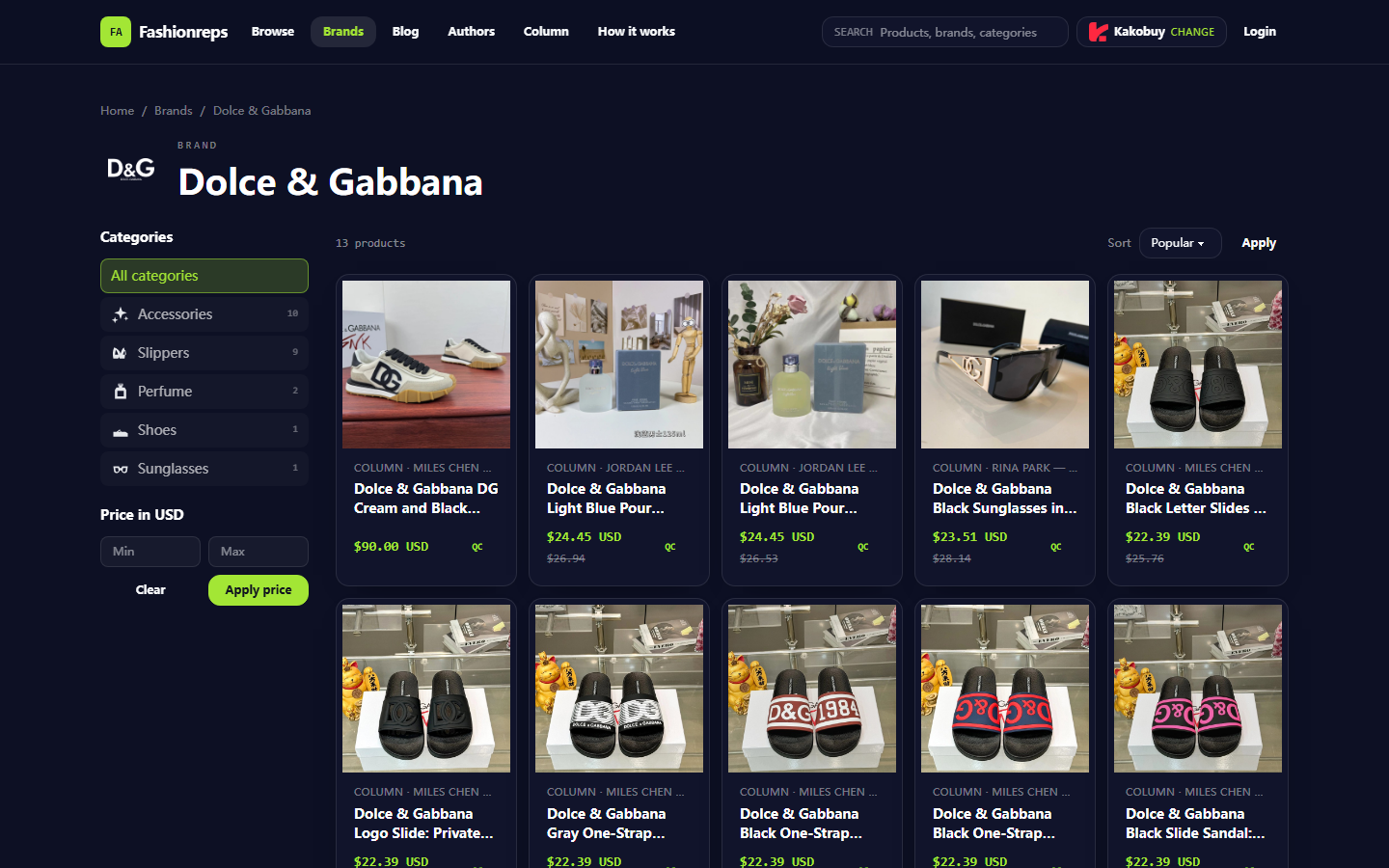
The page information was verified on October 19, 2026. The page shows that the Dolce & Gabbana brand catalog has 13 products, with the accessories category showing 10 entries; the currently visible catalog includes different types such as sunglasses, perfumes, shoes, and slippers. Because this catalog snapshot did not provide item-by-item product details or QC images, the following focuses on establishing a repeatable pre-purchase checking method.

Defining the scope of pre-purchase review for Dolce Gabbana accessories
Here, "accessories" cannot be simply understood as all products with the Dolce & Gabbana logo. You should first confirm whether the specific product is sunglasses, bags, small leather goods, jewelry, belts, or other accessories before deciding what to check. Key risks vary by category: sunglasses focus on lenses, hinges, and size; bags focus on edges, hardware, and interior compartments; jewelry focuses on connections, plating, and wearing safety.
This review covers four questions:
- Does the page clearly show the specific style, color, and available sizes?
- Do the main image, product specifications, and QC images point to the same item?
- Is there sufficiently clear visible evidence for hardware, edges, connections, and storage structure?
- Is the product suitable for commuting, travel, or ordinary daily carry, and which usage scenarios should not be assumed as applicable?
This article does not apply to scenarios requiring authentication, material composition verification, optical performance verification, waterproof rating verification, or destination country compliance verification. When the listing cannot prove these matters, they should be listed as items to be verified rather than giving a definite conclusion.
Confirming specific style, color, size, and links from the fashion-reps listing
Fashion-reps positioning is to help users discover products, view available QC information, and go to external shopping agents to complete orders. Orders, payments, and logistics are handled by the chosen agent's website. Therefore, the product discovery page, the agent order page, and the warehouse QC page are not the same layer of evidence; information from one layer cannot be automatically extended to the other two.
After entering a specific product page, first record the following fields:
- Product name and category.
- Color or colorway shown on the page.
- Available sizes, units, and applicable range.
- Reference price, currency, and display date on the page.
- Whether there is a clear correspondence between the product main image, specification text, and QC images.
- The agent platform that the Buy button ultimately redirects to.
- Whether the product page is still accessible, or if there are redirects, blank pages, or loading failures.
In this brand catalog, there is a black sunglasses entry described as a frame for daily and outdoor use; however, the catalog summary does not provide enough information to confirm lens material, temple length, hinge structure, or actual wearing size. Therefore, these cannot be directly inferred from the catalog name.
If the product name only states color and general type without model number, size, or clear product images, it should be marked as "insufficient information" and missing specifications should not be filled in based on common brand styles. 📏
Recording visible information for hardware, edges, connections, and storage structure item by item
The durability of accessories often depends on small parts. When checking, separate "facts clearly shown on the page" from "limited editorial judgments based on images."
Hardware inspection can start from these locations:
- Whether buckles, hinges, zipper pulls, or decorative metal parts appear completely in the image.
- Whether surface color is consistent across different images.
- Whether the connection between hardware and main body is blocked, cropped, or heavily compressed.
- Whether edges, seams, and areas that may bear tension are visible.
- Whether there are obvious signs of fading, dents, misalignment, or burrs.
Edge inspection should focus on:
- Whether edges of leather, fabric, plastic, or composite materials are even.
- Whether binding, coating, or stitching is continuous.
- Whether there are visible signs of cracking, glue overflow, or indentation at corners.
- Whether the main image and QC image show the same edge, rather than using different angles to hide details.
Connection inspection should focus on:
- How chains, straps, temples, charms, or buckles are attached to the main body.
- Whether connectors have obvious gaps or concentrated stress points.
- Whether movable structures remain in natural positions in the image.
- Whether there are sufficiently close-up photos to support a judgment, rather than only showing distant shots.
Storage structure requires confirming:
- Whether interior pockets, card slots, compartments, or protective cases are clearly shown.
- Whether the page states if accessories are included with the product.
- Whether packaging or storage items are just display props or actually included in the order.
- Whether the product may be affected by squeezing, friction, or lack of protection during shipping.
Without clear images, you can only write "cannot be confirmed from current evidence," not "solid workmanship," "premium hardware," or "suitable for long-term use." 🔍
Cross-checking the correspondence between product specifications, main image, and QC images
A valid set of evidence requires at least establishing correspondence among three things: product specification, main image, and QC images. If the three cannot point to the same style, details from one image cannot be used to support conclusions about another.
| Check object | What can be confirmed | What cannot be directly confirmed |
|---|---|---|
| Product specifications | Color, size, material, or accessory descriptions explicitly written on the page | Unwritten durability, authenticity, actual weight, and wearing comfort |
| Main image | Product appearance, overall silhouette, and display angle | Actual batch condition, fine defects, and warehouse shipping condition |
| QC images | Local condition visible in the photographed batch | Areas not photographed, long-term use performance, and post-shipping condition |
When inconsistencies are found, handle them in the following order:
- Compare whether product name, color, and size are consistent.
- Check the logo position, structural outline, and number of accessories in the main image and QC images.
- Confirm whether the QC images are from the current order, not generic display images.
- Record missing fields and request additional photos from the agent or seller.
- Before evidence is complete, do not mark the product as "ready to order."
If the page shows a brand name but lacks clear model, material, or detail evidence, the brand name alone only helps classification and cannot be proof of quality, authenticity, or lifespan.
Analyzing suitability for commuting, travel, and daily carry scenarios
Commuting scenarios usually require stable storage and low risk of bumps. If the product lacks a protective case, interior pocket, or clear securing structure, placing it in a full bag during commute may increase friction and compression risks. For sunglasses, confirm whether lenses and temples have adequate protection; do not infer specific protective capabilities from the words "outdoor use."
Travel scenarios require extra attention to volume, weight, security carry, and luggage compression. Small size does not necessarily mean suitable for carry-on; accessories without hard protective structures are more susceptible to pressure in checked luggage. Before departure, also check the destination country's regulations on replicas, knockoffs, products with special materials, and import declaration. Do not reduce risks by under-declaring, splitting orders, or evading inspection.
Daily carry scenarios should be judged based on actual frequency of use. If the product contains movable hinges, thin chains, narrow edges, or protruding decorations, long-term friction, sweat, rain, and high temperatures may change usage conditions. If the page does not provide proof of water resistance, sweat resistance, UV resistance, or plating lifespan, treat it as ordinary decorative accessory and avoid using it as professional functional equipment. ☔
Separating page facts, user feedback clues, and editorial judgments
Page facts are content currently explicitly displayed on the product page, such as brand catalog, category, product name, display images, and reference price. They should note the verification date because prices, inventory, page status, and agent redirects may change.
User feedback clues can only serve as direction for further checking. If feedback lacks corresponding product, full context, or cannot confirm which batch the comment refers to, it cannot be written as a general conclusion. A single review cannot prove that the same problem exists or does not exist in all orders.
Editorial judgments should clearly state their basis. For example:
- Page fact: The catalog shows a black sunglasses and places it under the Dolce & Gabbana brand page.
- Evidence limitation: The current catalog summary does not provide lens specifications, temple length, or per-item QC images.
- Editorial judgment: Until specific product page and corresponding QC images are obtained, it is insufficient to judge whether it is suitable for prolonged outdoor wear.
This distinction avoids writing visual impressions as test results and avoids implying that the editor has purchased, received, worn, or tested the product. This article adopts the perspective of Panda-Buy Editorial Desk, organizing pre-purchase checking methods based solely on visible page information and verification boundaries.
Stop conditions when images are blurry, specifications missing, or product correspondence impossible
If any of the following occurs, pause ordering or pause publishing affirmative evaluations:
- Product page is inaccessible, or redirected to an empty page, tab page, or unrelated page.
- Product name, color, size cannot be matched with images.
- Main image exists, but there are insufficient clear detail images to support hardware and connection judgments.
- QC images are blurry, severely cropped, or cannot be confirmed to belong to the current product.
- Page specifications are inconsistent with the agent order page.
- Page does not state whether key accessories are included in the order.
- Price, inventory, or link status was not re-verified before publishing.
- Product involves destination country restrictions but relevant import rule checks have not been completed.
Stopping does not mean the product necessarily has problems; it means current evidence is insufficient to support the next judgment. At this time, save page records, request specified angle photos from the agent or seller, and re-check after evidence is complete. 🛑
Pre-order evidence checklist and next verification steps
Before ordering, you can go through the following checklist:
- Confirmed specific category, style, and color.
- Recorded size, unit, and applicable conditions.
- Saved reference price and verification date shown on the product page.
- Confirmed main image, specifications, and QC images belong to the same product.
- Checked visible condition of hardware, edges, connections, and storage structure.
- Distinguished page facts, user feedback clues, and editorial judgments.
- Confirmed the chosen agent and its ordering, warehouse inspection, and after-sales rules.
- Understood destination country's declaration, taxes, import restrictions, and return/exchange conditions.
- Decided which questions need to be confirmed with the agent or seller before payment.
Next, go to the specific product page and re-verify link status and visible specifications; if the page offers warehouse QC service, compare color, structure, hardware, and accessory counts item by item after receiving photos. Only when the product can be clearly identified, key details are clearly visible, destination country rules allow import, and after-sales conditions are acceptable, is it appropriate to proceed with ordering.
For this catalog information, the most important conclusion is not "this accessory is definitely suitable for daily use," but: the current public summary is sufficient to confirm the brand catalog and partial category information, yet insufficient to replace specific product pages, per-item QC images, material descriptions, and destination country compliance verification.