 By Clara WinslowChocolate, confectionery trends, sensory evaluation
Dior Oblique Backpack for Short Commutes: Strap & Cleaning
For short commutes or one-to-two-day light trips, what matters most isn't whether the backpack looks striking, but whether the strap attachment has sufficient evidence, whether the internal organization fits your actual devices, and whether surface maintenance is within an acceptable range. For this Dior Oblique-style embroidered backpack, the page information supports the dimensions, appearance, and some series-level feedback, but it is not enough to prove
- Published
- Updated
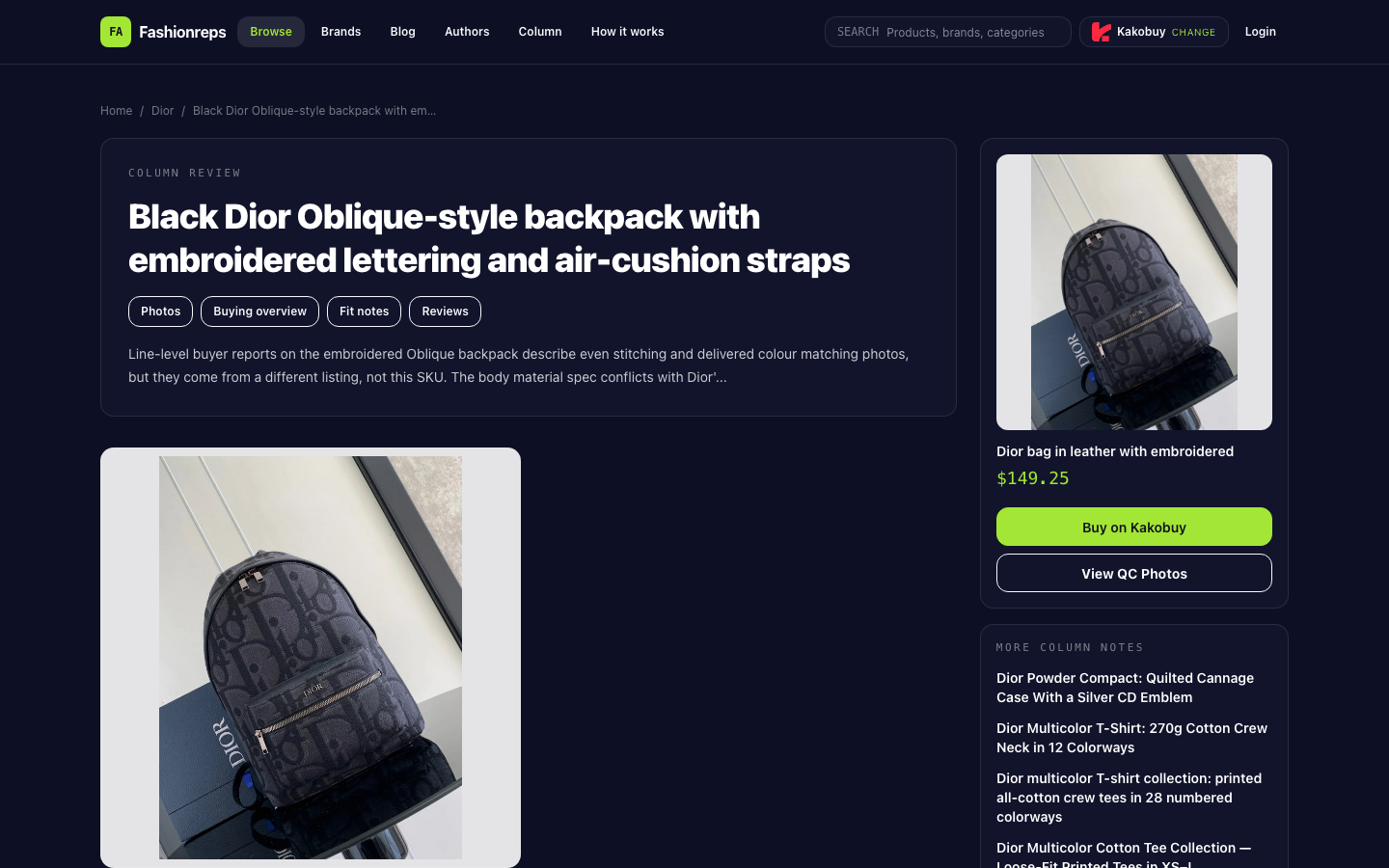
For short commutes or one-to-two-day light trips, what matters most isn't whether the backpack looks striking, but whether the strap attachment has sufficient evidence, whether the internal organization fits your actual devices, and whether surface maintenance is within an acceptable range. For this Dior Oblique-style embroidered backpack, the page information supports the dimensions, appearance, and some series-level feedback, but it is not enough to prove the long-term durability of this specific item or the actual specifications of its laptop compartment.

Conclusion First: It's a Consideration, but Not Suitable for Ordering Based Solely on Page Fields
If your short commute mainly involves carrying clothes, chargers, documents, and a few daily essentials, this backpack's page dimensions seem to provide a certain capacity foundation. The information shows catalog dimensions of 30 × 15 × 42 cm, a black Dior Oblique-style embroidered design, and straps with cushioning structure.
However, the page also lists leather body, polyester lining, and a 10-inch laptop compartment, which are not entirely consistent with the typical fabric structure of an embroidered Oblique. While the same external dimensions could potentially accommodate larger devices, this does not replace actual measurement of the internal pocket size. Therefore, whether it suits a commute depends on your ability to fill in key evidence before payment.
Three Risks Worth Focusing on for Short Commutes
1. Strap Attachment Points Are a Priority Inspection Area
In series-level feedback on Oblique backpacks, some users mentioned pulling threads or wear at the bottom attachment points of the straps. This information only indicates that the connection area deserves special attention; it does not directly prove that this specific item has the same problem, nor does it infer its lifespan.
Before ordering, ask the seller to provide additional close-up photos of the following details:
- Close-ups of the front, back, and side of the strap-to-body attachment points
- Whether there are multiple reinforcement stitches at the attachment points
- Whether the stitching is even, and whether there are skipped stitches, loose threads, or local puckering
- Whether the strap adjusters and load-bearing points are deformed or show obvious fraying
- Whether the attachment structures on both straps are symmetrical
If the seller only provides distant full-bag photos that don't show the load-bearing points clearly, you should not treat "the page looks sturdy" as evidence of durability.
2. Embroidered or Fabric Surfaces Require Routine Maintenance
The information mentions that Oblique-type fabric surfaces are prone to staining and require regular cleaning and maintenance. For a short commute, the backpack often comes into contact with public transit seats, desk edges, and areas near the floor. The dark color may not show dirt immediately, but that doesn't mean the surface doesn't need care.
A safer approach is to:
- Confirm before payment whether the seller can provide material and cleaning advice
- Avoid using unverified strong cleaning agents or bleach products
- Test on a small, inconspicuous area first
- Avoid prolonged soaking or rubbing of the embroidered areas
- Make sure the surface is dry before storage to prevent moisture residue
If you want a backpack that can withstand frequent commutes, rain exposure, and rough cleaning over the long term, you should incorporate maintenance requirements into your purchase decision, rather than focusing only on the pattern and capacity.
3. Laptop Compartment Specifications Cannot Be Taken at Face Value from Page Numbers
The page information lists a 10-inch laptop compartment, but the external dimensions are 30 × 15 × 42 cm. This combination suggests the possibility of an under-specified compartment or outdated fields, but current evidence is insufficient to confirm whether the actual compartment can fit larger devices.
If you need to carry a tablet or laptop, before payment, ask the seller to measure and photograph the following:
- Actual width and height of the internal compartment
- Compartment opening size, not just the bottom dimensions
- Whether the compartment has a separate padded layer
- Whether the device would press against the zipper or embroidered area when inserted
- Whether A4 documents can lie flat and be zipped smoothly
Without actual measurements, you can only judge that it might suit light daily items, not confirm it fits your specific laptop model.
Page Information and Series-Level Feedback Should Be Viewed Separately
This product page can provide the current item's appearance, catalog dimensions, and labeled specifications, but some durability clues come from user feedback on the same series or similar Oblique backpacks. These two types of information should not be conflated.
Item-specific information includes the black embroidered appearance, 30 × 15 × 42 cm catalog dimensions, the material fields listed on the page, and the 10-inch laptop compartment description. Series-level feedback involves embroidery performance, wear at strap attachment points, surfaces prone to staining, and feelings about zippers and hardware. This feedback can help you identify inspection priorities, but it cannot replace actual QC photos of the current item.
The page also shows a reference price of $149.25. Final product price, service fees, and international shipping need to be confirmed on the shopping agent website. This reference price does not equal the final cost of receiving the item, nor does it allow inference of stock, shipping costs, or after-sales conditions.
Evidence Checklist Before Payment
It is recommended to divide the supplementary evidence into four groups and confirm each item before payment:
- Strap attachment
- Close-ups of both attachment points
- Details of reinforcement stitching
- Photos of adjusters and load-bearing points
- Internal organization
- Actual measured dimensions of the laptop compartment
- Photos of compartment opening and padding
- Photos of A4 documents or your actual device inserted
- Surface and hardware
- Embroidery density, loose threads, and edge details
- Photos near the bottom, corners, and zippers
- Zipper closure status and photos of hardware connections
- Purchase conditions
- Whether current stock is still available
- Final product price and service fees
- International shipping cost and available shipping options
- Resolution process if specifications do not match
If the seller cannot provide this information, especially evidence of strap attachment and internal compartments, it should be regarded as insufficient evidence rather than assuming the product matches the page description.
Applicable Boundaries
This backpack can be a candidate for a short commute, provided that you mainly need medium-capacity daily storage, can accept the maintenance of an embroidered or fabric surface, and are willing to verify strap attachment and internal compartments before payment.
If you must reliably carry a specific laptop size, or want clear proof of a leather body, it is not advisable to rely solely on the current page fields. If you cannot accept the potential wear risk at strap attachment points and are unwilling to clean and maintain regularly, then the evidence base and usage boundaries of this product are not solid enough.
The final judgment can be simplified to one sentence: If you are willing to request key close-up photos and treat it as a short-trip backpack that requires maintenance, you can continue to verify; if you need clear laptop capacity, material, and long-term durability guarantees, then pause payment until the seller provides verifiable physical evidence.