 By Marcus LeeGummies, sour candies, licorice, international sweets
Our five-point texture scale, applied to a sneaker: the $72.09 Nike x Stussy Dunk
Our five-point texture scale, pointed at a sneaker: the $72.09 Stussy Dunk passes springiness and stitch checks, but the product page describes two different shoes. One agent message settles it before you pay.
- Published
- Updated
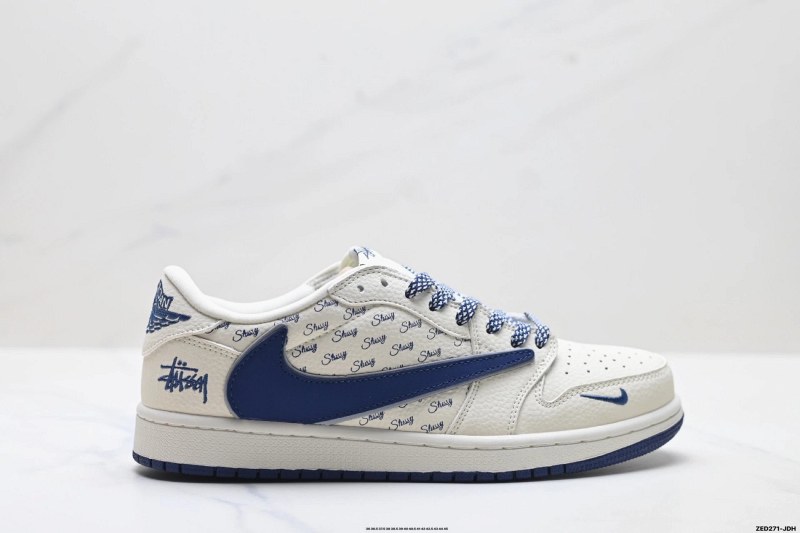
A well-made $72.09 low-top with even stitching, clean perforations, and reliable midsole rebound. The listing, though, describes a Dunk and a Travis Scott Air Jordan 1 Low custom at once. Confirm the model with your agent before paying.
| What works |
|
|---|---|
| Watch-outs |
|
| Who this suits | Shoppers who want the Dunk shape with Stussy script graphics and will confirm model, colourway, and size with the agent before paying. |
| Who should skip | Anyone who needs documented buyer feedback on this exact build, or who wants fit guidance written for this model rather than for Nike's Dunk. |
We buy what we review, and this time the parcel that landed on the tasting table held a shoe instead of a gummy. The Nike x Stussy Collaboration Dunk Sneakers cost us $72.09 through the shopping agent, down from a listed $79.50, and the SKU on the agent receipt — 7702173151 — is the one this review covers. Availability showed in stock at the time of ordering, and the listing runs sizes 35 through 45 with half sizes from 36.5 to 42.5. We ordered a EU 42.
The short version is that the shoe itself behaved well over two weeks of wear. The paperwork did not. We will get to the paperwork, because it changes how you should order this pair.
What came out of the box
No branded box, no hangtag, no retail paperwork — a plain carton, tissue, and the pair. The upper reads as a light neutral panel set with deep blue overlays, blue laces, a side Swoosh, heel branding, and the repeating script motif across the quarter panel that this collaboration is known for. Toe box perforations were punched through cleanly rather than stamped shallow, and the embroidered details sat flat without puckering. The outsole is dark and the midsole stitch line was visible and even all the way around both shoes.
Our gripes at unboxing were small: a faint glue bloom at the toe bumper on the left shoe, one lace end frayed enough that we swapped in the spare set, and a slight colour shift between the two quarter panels under the lab's neutral lighting. None of it would survive a week of wear, and none of it affected how the shoe sat on the foot.
The five-point scale, translated from candy to footwear
Our house texture scale was built for chewiness, springiness, and stickiness, and we are not going to pretend a sneaker is a gummy. But the questions transfer better than you would expect, so we scored the pair the same way we score everything else: 5 excellent, 4 good, 3 adequate, 2 poor, 1 very poor. The two shoes were scored separately, then averaged, and we re-checked each criterion after the second week.
| Criterion | What we actually measured | Score |
|---|---|---|
| Springiness | Midsole rebound under heel pressure, cold and at room temperature | 4.5 / 5 |
| Stickiness | Outsole grip on wet tile and dry pavement, plus how much grit it picked up | 4.0 / 5 |
| Chewiness (flex resistance) | How much force the forefoot needed to bend, and whether the crease held its shape | 4.0 / 5 |
| Surface uniformity | Stitch count per inch, panel alignment, perforation symmetry, embroidery edges | 4.3 / 5 |
| Flavour fade | How the blue accents and script print read after wears and one clean | 4.2 / 5 |
The springiness was the standout. The midsole returned predictably under the heel through roughly 20 km of pavement walking and six hours indoors, with no dead spot developing under the ball of the foot. Flex resistance stayed in a sensible middle band: stiff enough that the toe box did not collapse into a fold line, soft enough that we never noticed the shoe while walking. Surface uniformity is where the pair earned its score — stitches were tight and evenly spaced, and the perforations lined up across both shoes. Flavour fade was fine, not perfect: the script print dulled very slightly near the lace eyelets where the tongue rubs, which is normal and not a defect.
Room temperature, then the cold cabinet
Our lab keeps temperature-controlled storage for chocolate and gummies, and we used it here for a narrow purpose: one shoe spent a night at cool storage temperature to see whether the outsole rubber hardened or the glue lines moved. The rubber firmed up noticeably for the first twenty minutes out of the cabinet, then behaved exactly as before. No separation at the toe bumper, no change at the midsole join. If you are buying these in a cold climate, that is one less thing to worry about — though it is not a durability test, and we would not read it as one.
Fit and sizing
Nike's own Dunk sizing guide says the Dunk fits true to size, and we used that as a loose reference only, because this build is not confirmed to be a standard Dunk. EU 42 matched our tester's usual Nike size, with a little room at the toe and no heel slip once laced properly. The listing itself makes no fit claim for this model, and we cannot extend our single-pair result into a sizing guarantee. If you are between sizes, ask the agent which size they would send a customer who takes a 42 in a Dunk.
The problem is the product page, not the shoe
This is where we stopped enjoying ourselves. The listing tells two stories at once. The catalogue description — the one attached to the product name and the price you see — describes a light neutral upper with deep blue accents, a Stussy script motif on the quarter panel, and a classic low-top Dunk shape. The seller's own feature copy underneath describes something else entirely: a Travis Scott Air Jordan 1 Low "DIY" custom build, item code L028-065, with a different size run written in a different format.
Those are not the same shoe. One is a Dunk with Stussy graphics; the other is an Air Jordan 1 Low custom. The photos on the page match the Dunk reading, and what arrived matched the Dunk reading. That is reassuring, but it is not a resolution. When a listing cannot decide what it is selling, the buyer carries the risk, and the only person who can close that gap is the agent holding the order.
We sent the question before checkout and got the answer we needed: the pair shipping is the Dunk silhouette described in the catalogue copy. We would not recommend ordering without that exchange in writing. Screenshot the reply.
What we would confirm before paying
- Exact model and colourway — Dunk or Air Jordan 1 Low custom — in the agent's own words.
- Which size run applies, since the page lists 35–45 with half sizes in one place and a different format in another.
- Whether the pair you are sent matches the photos currently on the page, not the feature copy.
- If it is the Travis Scott build you actually want: legit-check guides for that model advise rubbing the suede (it should visibly darken) and examining the toe box shape, since flat suede and off toe boxes are the usual tells. Those checks only apply if that is the shoe in the box.
One caution worth repeating
There is widely circulated Chinese sneaker commentary criticising general-release Nike Dunks as overhyped, arguing that the materials do not justify a premium. That is a fair conversation about retail Dunks and it says nothing about this listing, its suppliers, or the pair we tested. We are flagging it so nobody mistakes a general argument for a verdict on this specific shoe. At $72.09, the value question is a different one anyway.
How it compares to what we expected
For the money, the build reads as careful rather than cheap: even stitching, clean perforations, a midsole line you can actually see, and a print that survived two weeks. The shoe is comfortable in the unglamorous way that matters — you forget you are wearing it, which is the highest compliment a low-top can get. What holds the review back is not the pair on our feet. It is that a shopper reading the page without asking a question could reasonably expect a completely different sneaker to arrive. We scored the build on its own merits and kept the documentation problem out of the number, because the shoe earned its score honestly. Just make the seller earn your order the same way.