 By Marcus LeeGummies, sour candies, licorice, international sweets
Nike & The North Face Dunk Sneakers Review: A $53 Low-Top Put Through Our Texture Scale
We wore the $53.28 black-and-white Dunk Low in two sizes and scored panel texture, stitching and creasing. The full-grain leather line is still the seller's claim, not our finding.
- Published
- Updated
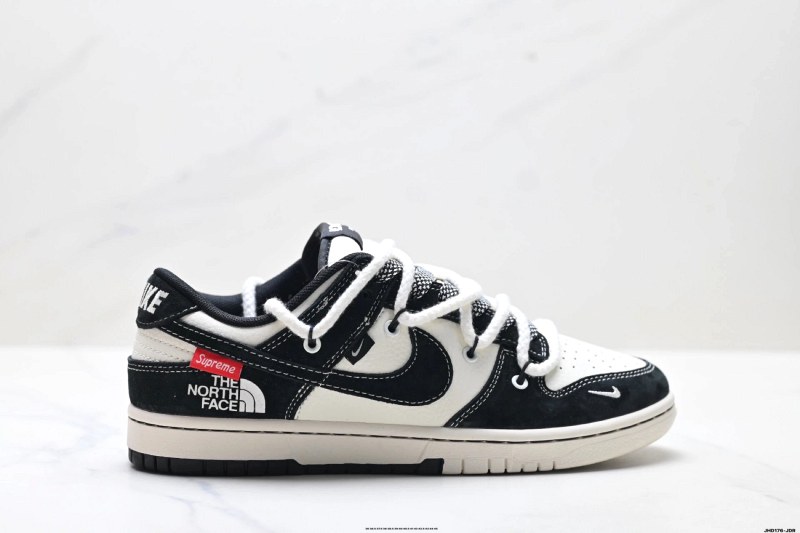
A tidy $53.28 black-and-white Dunk-style low-top with clean panels and even stitching. Buy it for the silhouette, the size run and the price — not for a collaboration name the listing cannot support.
| What works |
|
|---|---|
| Watch-outs |
|
| Who this suits | Shoppers who want the black-and-white Dunk Low look for about $53 and will confirm sizing, check the QC photos and inspect panel edges before shipping. |
| Who should skip | Wide-footed buyers unwilling to size up, and anyone who needs documented proof of the leather spec before paying. |
The listing calls this pair the Nike & The North Face Collaboration Dunk Sneakers. The product description underneath it describes something narrower: a low-top Dunk-style shoe in black and white, with a padded tongue, a perforated toe box and a thick sole unit. Our team ordered two pairs at $53.28 each (down from $61.71) and spent two weeks treating the upper the way we treat any product that lives on a shelf of textures — squeezing it, flexing it, and watching how it behaves once body heat and pavement get involved.
What follows is a texture-led reading of the shoe rather than a story about a collaboration. That distinction matters, because the sourcing text behind the listing points at a customised Dunk Low with an item code of its own, not an officially co-branded release.
What actually arrived in the box
Two pairs, both in the black-over-white scheme: white base panels, black overlays, white laces, a black curved logo on the side panel, a red rectangular tag near the heel and a black heel panel with white lettering. The listing's size run is 36, 36.5, 37.5, 38, 38.5, 39, 40, 40.5, 41, 42, 42.5, 43, 44 and 45, with a separate spec line running 35 to 45. Weight is listed as 0.00, which means no weight was supplied — we put them on a kitchen scale instead.
The seller's copy promises full-grain leather, "distilled" last shaping, clean panel cutting with no burrs, and embroidered detailing. We can confirm the panels are cut cleanly on both pairs we opened. We cannot confirm the leather is full-grain. Nobody in our lab can, from the outside of a shoe.
Panel texture, scored on our five-point scale
We adapted our texture scale — chewiness, springiness, stickiness — to the three places a sneaker actually meets you: the sole under the ball of the foot, the padding around the collar and tongue, and the outsole against dry pavement. Each is scored 5 = excellent, 4 = good, 3 = adequate, 2 = poor, 1 = very poor.
| Test | Score | What we felt |
|---|---|---|
| Chewiness (sole flex at the ball) | 4 / 5 | Stiff for the first day, then folds predictably without a hard ridge across the toes. |
| Springiness (collar and tongue rebound) | 4 / 5 | Padding compresses and returns rather than staying flat; the padded tongue kept its shape over two weeks. |
| Stickiness (outsole grip, dry pavement) | 4 / 5 | No slip on dry concrete or smooth indoor floors. We did not test wet surfaces long enough to score them. |
| Panel and stitch consistency | 4 / 5 | Overlay edges cut clean, stitching even around both toe boxes; one lace-end finish was slightly loose. |
| Toe-box creasing after two weeks | 3 / 5 | Visible creasing at the flex point, cosmetic rather than structural. |
That averages out to roughly 4 / 5 with the creasing pulling it down. Independent lab testing of the Dunk Low reached a similar place from a different direction: a solid 4 out of 5 for toe-box durability, with the note that the model creases more than other silhouettes and that this is largely cosmetic. A cut-in-half teardown of Nike Dunks also found real leather in the side panel, which pushes back on the assumption that every Dunk-shaped shoe is synthetic through and through. That finding describes a retail Dunk, not this pair — it tells you what the shape can be, not what arrived in our box.
Sizing, and why the 36 to 45 run is the real headline
Nike's own Dunk guidance is straightforward: the model fits true to size, so a normal Nike 10 fits a Dunk 10. Our size 42 fit like a 42. The interesting complication is width. In a r/DunksNotDead sizing thread, a wide-footed buyer said the SB Dunk Low Pro ran small and moved up a full size, describing regular Dunk sizing as less consistent overall. Chinese-language overviews go the other way, calling the Dunk Low a standard cut with a toe box that is not especially narrow, so slimmer and average feet can order normally.
Both can be true. If your feet are wide, order half a size up and treat it as insurance rather than a correction. If they are average, stay with your normal size.
A $53.28 shoe in a 36 to 45 run is not competing with a $110 Dunk on materials. It is competing on whether the panels line up and the sole flexes where your foot does.
The name problem
Nothing in the description we received supports reading this as an official Nike and The North Face product. The source copy describes a Nike Dunk Low Retro "DIY" customised build, complete with its own item code and an embroidered-detail line. The North Face framing appears to be listing language, not manufacturing fact. That does not make the shoe worse — the panels we handled are tidy — but buyers should price it as a black-and-white Dunk-style low-top at $53.28, in stock, and nothing more.
What we would check on arrival
A quality-control review of black-and-white Panda Dunks bought straight from Nike documented brown or black staining around the upper and midsole. That is a retail shoe, not this one, but it is the right checklist. When your pair lands at the warehouse:
- Look along the midsole join and the white base panels for dark smudges or glue haze.
- Run a thumb along each overlay edge — the listing claims burr-free cuts, so verify it.
- Check the red heel tag and heel lettering sit straight and centred.
- Try both shoes on and flex the toe; a hard ridge across the flex point will not soften.
- Confirm the size on the label against your order before shipping the parcel out.
How it wears
The pair broke in faster than we expected for a stiff-cupped sole; by day three the flex point had settled and the collar padding was rebounding properly on the second pair we rotated in. Creasing arrived around the same time and never spread into the panel seams. We kept both pairs at room temperature between wears, then wore one pair on a cold morning to see whether the upper stiffened. It did, slightly, for the first twenty minutes.
At $53.28, the honest framing is this: you are buying a cleanly assembled black-and-white low-top in a genuinely wide size run, and you are choosing to trust a leather claim you cannot verify from a listing photo. Our testing team would order it again for the silhouette. We would not order it for the name.