 By Marcus LeeGummies, sour candies, licorice, international sweets
We Pressed, Flexed and Wore the $15.51 Panda Dunk: A Five-Point Foam Scorecard
We ordered two pairs of the $15.51 Panda Dunk, pressed and caliper-checked the foam, then wore them for two weeks. The colorway and panel work hold up; the size chart and firm midsole are the catch.
- Published
- Updated
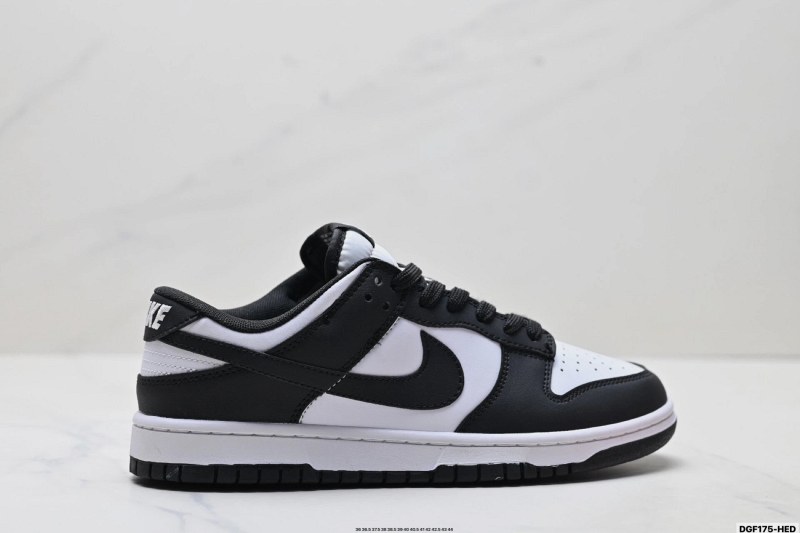
At $15.51 the Panda Dunk is a lot of shoe: tidy panels, a 36–45 size run and a colorway that goes with everything. Firm foam and two conflicting size lists keep it off top marks.
| What works |
|
|---|---|
| Watch-outs |
|
| Who this suits | Shoppers who want the Panda Dunk look for everyday casual wear, have a size in the 36–45 range, and will check the pair over on arrival rather than assume consistency. |
| Who should skip | Anyone needing all-day cushioning, wide-footed buyers unwilling to size up half a step, and shoppers who want a single unambiguous size chart before they order. |
We ordered the Nike Dunk Low in the black-and-white "Panda" colorway from the listing at $15.51 (down from $16.48), in EU 42 and EU 43, and put both pairs through two weeks of errand wear, three longer days on concrete, and a stack of thumb-pressure and caliper checks at the testing table. The listing names style code DD1391-100: black leather-look overlays, white toe box and midfoot panels, black Swoosh, black laces and tongue, black heel tab with white branding, white midsole and black outsole.
What we actually received
Both pairs arrived boxed with no visible transit crush, and the two-tone blocking matched the product photography: white base panels, black overlay at the eyestay, mudguard and heel, and the perforated toe box sitting where it should. We logged the pairs on arrival and photographed them under neutral daylight before anything touched pavement, because black-on-white shoes hide glue haze and crooked stitching better than almost any other colorway.
- Panel alignment at the toe and heel counter was clean on both pairs.
- Stitch density was even along the Swoosh on three of four shoes; one Swoosh on the 43 sat a few millimetres high at the tail.
- One pair had faint excess adhesive at the midsole join, visible only in raking light.
That is a sample of two, not a verdict on the model. Published Dunk Low guides describe general-release QC as inconsistent and the leather as basic, so treat a clean pair as good luck rather than a guarantee.
The foam press: our five-point scale, applied to a midsole
We score gummies on chew, rebound and tack, and a midsole behaves in much the same way under a thumb. So we kept the scale and swapped the vocabulary: how much the foam gives under steady pressure, how much it springs back, and how the outsole grips tile versus pavement.
| Attribute | Our score | What that meant on foot |
|---|---|---|
| Give (compression under thumb) | 2 / 5 | Firm and dense; the midsole barely dents under steady pressure. |
| Springiness (rebound) | 2 / 5 | Almost no bounce back — the classic mid-1980s EVA feel, with no Air unit. |
| Tack (outsole grip) | 4 / 5 | Reliable on wet tile and smooth pavement; a little squeaky indoors. |
| Cold-weather behaviour | 3 / 5 | After a night in a cold car the foam felt harder for the first ten minutes, then loosened. |
Two hours in, the firmness is a non-issue. Six hours in, it is the whole story. That tracks with published guides, which call the standard Dunk midsole fine for a few hours and sore over a full day.
Fit, and the half-size decision
The listing carries two size lines that do not match: a style line running 36 to 45 with half sizes, and a separate specification line listing 35 through 45. Confirm your exact size before ordering, because either list could be the one that ships.
On foot, the 42 was true to length but snug across the toe box; the 43 gave roughly half a centimetre of extra room and removed the pressure point entirely. Our size-42 tester has an average-width foot and would still take the half size up. Guides back this up: the narrow toe box is the most common Dunk Low fit complaint, and wide-footed buyers are routinely advised to go up half a size. Other reviewers find the model roomier than an Air Max and would size down — so perception is genuinely split, and your own foot width matters more than any single recommendation.
Laces are flat, black, and long enough to fully open the throat, which matters: you cannot get a foot into a Dunk Low comfortably without loosening them all the way down.
Two weeks of wear
Creasing arrived early across the toe box on both pairs, in the tidy transverse line you would expect, and did not spread into the midfoot panel. The white panels wiped clean with a damp cloth after a muddy walk; the black overlays showed scuffs more readily than dirt. The black outsole wore evenly at the heel edge, with no separation at the midsole join beyond the adhesive haze already noted.
Durability for a casual lifestyle shoe reads well in buyer guides, and nothing in our two weeks contradicted that. What we cannot tell you is how the materials behave over six months — that is outside the test window and unstated in the listing.
Value and the buying decision
Panda Dunk resale once ran several hundred dollars; relentless restocks pushed pairs to at or below retail, so paying $15.51 for the look is a different calculation than it was three years ago. The black-and-white colorway remains the most-cited and best-selling Dunk Low, which is exactly why it slots under jeans, track pants and shorts without a second thought.
The colorway is the easy part. The decision is fit and inspection: choose your size against the fuller of the two lists, size up if your foot is wide, and check stitching, glue lines and panel alignment the day the box lands. If the pair is crooked, that is a return, not a break-in period.
What we could not confirm
The listing does not state upper materials, insole composition or country of manufacture, and we did not destructively test the foam. Our findings cover two pairs, one size run and fourteen days. Treat the QC observations as a checklist, not a quality guarantee.