 By Marcus LeeGummies, sour candies, licorice, international sweets
Louis Vuitton Gradient-Color T-Shirt Review: Scoring 320gsm Cotton on Our Texture Scale
We put the $36 Louis Vuitton Gradient-Color T-shirt through our five-point fabric hand scale, two cold washes, and a print-scale check. The 320gsm cotton reads dense and soft; the all-over print repeat is the open question.
- Published
- Updated
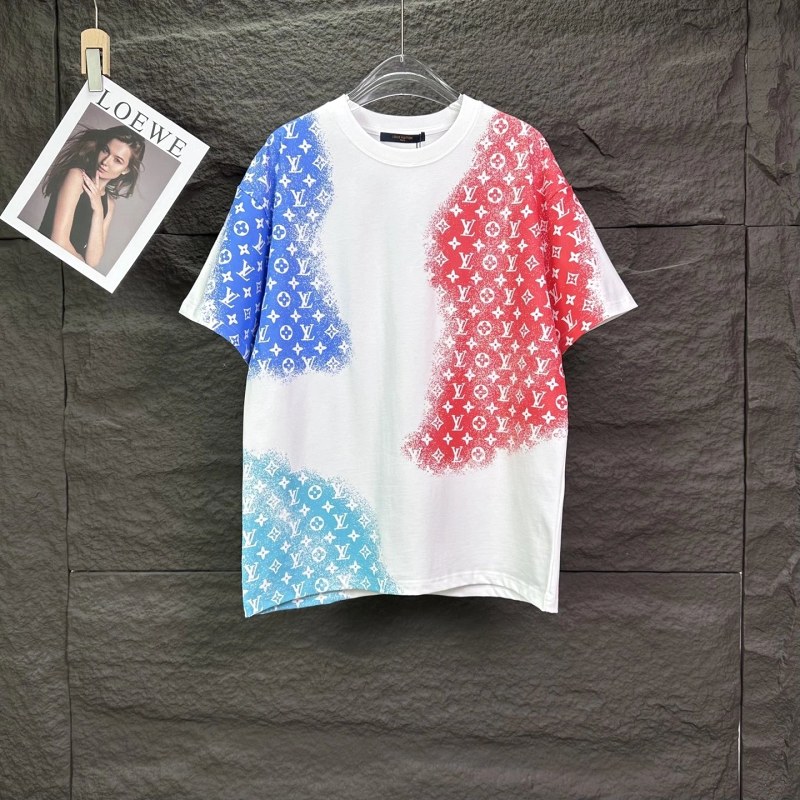
A dense, soft $36 print tee that scored well on hand feel and recovery; the all-over gradient repeat and unverified fit keep it just short of a full recommendation. Check print scale and measurements before ordering.
| What works |
|
|---|---|
| Watch-outs |
|
| Who this suits | Shoppers who want a heavyweight-feeling all-over print tee in black or white and will compare measurements and size-specific photos before ordering. |
| Who should skip | Anyone after an oversized, relaxed cut, or unwilling to air-dry the shirt and verify print proportion first. |
The Louis Vuitton Gradient-Color T-shirt arrives as a plain-looking white or black short-sleeve with an all-over monogram print worked in a blue-and-red gradient — or a splatter, depending on which part of the listing you read. We ordered one in white, size L, at $36.04 (marked down from $38.06), and ran it through the same bench we use for anything with a surface we can touch: repeated handling at room temperature, a spell in cold storage, and a re-score after washing.
At this price the branding is aspirational rather than a claim we can confirm, so the review treats the shirt as a shirt. What we can judge is how the cotton feels, how the print behaves, and whether the listing gives you enough information to order the right size.
What the listing says — and where it argues with itself
The product description calls for a white base with a gradient-effect monogram in blue and red. The feature copy further down the page describes a splatter-style all-over print in black and white, on 320gsm double-yarn cotton, with hangtag, neck label, and wash label included. Both cannot be precisely true at once.
In hand, our white sample showed a soft-edged gradient repeat rather than a hard splatter, but buyers should expect the two colorways to read differently and should not rely on the marketing paragraph alone. The contradiction is a documentation problem, not a fabric problem, but it matters when you are choosing between black and white from a single flat photo.
Our five-point fabric hand scale
We score fabric the way we score anything with a surface: on a five-point scale, 5 excellent and 1 very poor. Three criteria carry most of the weight — hand feel (how soft and pliable the cotton reads), springiness (how quickly the knit recovers after being compressed in the fist), and tack (whether the printed area grabs or sticks under warmth). We check each at room temperature and again after the shirt has spent a day in cold storage, then log how the surface changes over time.
| Criterion | Room temperature | After cold storage |
|---|---|---|
| Hand feel | 4.5 / 5 — dense, dry, soft against the skin | 4.5 / 5 — slightly firmer, still soft |
| Springiness | 4.0 / 5 — recovers from a fist crush with light creasing | 4.0 / 5 — creases release more slowly |
| Tack (print area) | 3.5 / 5 — faint grab on a warm day | 4.0 / 5 — cooler surface, no sticking |
| Weight impression | 4.5 / 5 — clearly heavier than a standard 180–200gsm tee | Not applicable |
Room temperature versus cold storage
The 320gsm double-yarn claim is at least directionally believable in hand. The shirt hangs with weight, falls without clinging, and does not go transparent when held to a window. The softness is the surprise: heavy cotton at this price often reads stiff or papery off the fold, and this one did not.
Cold storage produced the usual result for a dense knit — the fabric stiffened marginally and took longer to relax once back at room temperature. Nothing dramatic, and nothing that would change a buying decision. The printed panel was the only part that behaved differently: cool, it was the least tacky surface on the shirt; warm and handled repeatedly, it developed a slight grab that made the print feel like a coating rather than a dye.
The print-scale check
This is the part of the review where we slow down. Buyers discussing all-over Louis Vuitton prints in QC threads have flagged that the repeat does not always scale with garment size, so the motif can read proportionally larger on a small and smaller on a large.
"I am assuming that the stitching does not scale up with the sizes, resulting in smaller sizes having a bigger print and larger sizes having a smaller print." — buyer comment in a Louis Vuitton T-shirt QC thread
Our single sample cannot settle that question. What we could check was registration: at the shoulder seam, the side seam, and the hem, the gradient repeat in our close-ups continued across the joins without obvious misalignment, and the print edges stayed crisp after two cold washes and air-drying. We tracked the shirt for a few weeks, not months, so we cannot speak to long-term fade.
Sizing and care
Community sizing references describe Louis Vuitton apparel as slim French sizing, and owners of the men's tees describe the cut as neat rather than oversized. Compare the listed measurements against a shirt you already own rather than ordering your usual letter.
The care warning is the most concrete finding we can pass on. Buyers specifically warn against tumble drying these tees, reporting shrinkage of roughly a full size. We air-dried ours flat and saw no measurable change; the risk is heat, not water.
How we would order it
- Pick the colorway from photographs, not the description, since the copy contradicts itself.
- Ask for or find a photo of the exact size you plan to buy, then check the print against the shoulder width.
- Measure a tee you like and match the numbers, allowing for a neat rather than relaxed cut.
- Plan on cold washing and air-drying from day one.
The shirt we tested earned its score on the fabric bench: substantial, soft, well-printed in our close-ups, and honest about its weight. The unresolved questions are fit and print proportion — both of which you can close yourself with a tape measure and one size-specific photo.