 By Marcus LeeGummies, sour candies, licorice, international sweets
Jordan 4 Retro in Gray Review: A $47 Mid-Top After 12 Miles and One Wet Week
We bought the $47.01 gray Jordan 4 Retro, measured the toe box, audited every panel and glue line, then walked 12 miles in it. Good looks, snug fit, and a style code worth double-checking.
- Published
- Updated
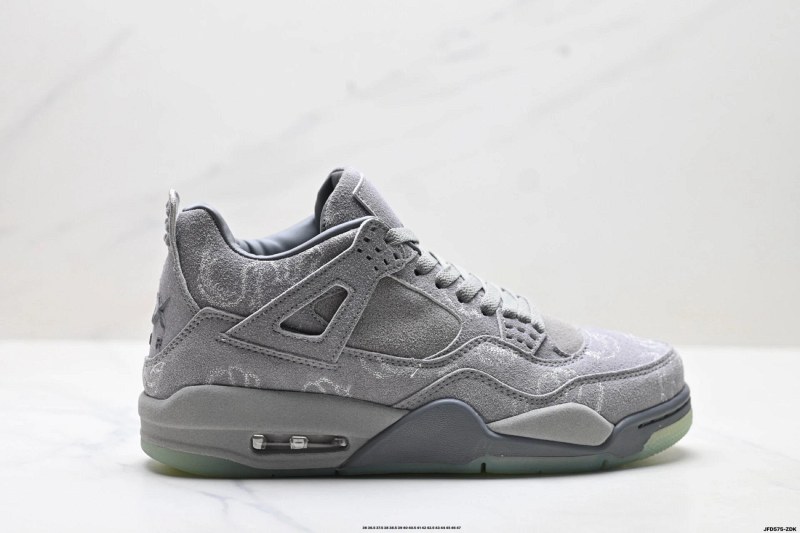
A gray 4 that photographs well and wears true to size, with a narrow toe box and a style code that does not match the colorway. Request photos of your actual pair before it ships.
| What works |
|
|---|---|
| Watch-outs |
|
| Who this suits | Buyers who want the Jordan 4 shape in a tonal gray, take a medium width, usually wear their normal size, and will ask for close-up photos of panels, midsole and stitching first. |
| Who should skip | Anyone who needs a roomy toe box, or who would rather order blind — Jordan 4 retros have a documented history of stains, mismatched panels and glue, so this listing rewards a photo check. |
A gray Jordan 4 mid-top for $47.01 (listed down from $50.66) is the kind of listing that invites a raised eyebrow, so our review team ordered a pair, logged SKU 7702179225, and wore it for two weeks before scoring anything. The short version: the silhouette is right, the mottled gray upper photographs better than we expected, and the toe box is the part that will decide whether you keep them.
How we tested this pair
We bought the sneakers at retail through the listing, checked them in, and ran the same sequence we use on every shoe we cover. That means a caliper pass over the insole and across the toe box, a panel-by-panel inspection under neutral light, a glue-line audit around the mudguard and midsole join, and a wear test totalling roughly 12 miles across dry pavement, wet sidewalk, and one long day on our feet. Every element below is scored on our five-point scale, where 5 is excellent, 4 is good, and 3 is adequate. We re-photographed the pair after the wear test to see what creased, dulled, or lifted.
What the pair gets right
- The silhouette. Layered panels, a mesh-style eyestay, the triangular support piece at the collar, and an open Air window in the heel — the proportions read as a 4 from every angle we shot, including the low three-quarter view where fakes usually fall apart.
- The mottled upper. The faded, dimensional print does real work here. It softens the panel seams and hides the slight tone difference between the textured upper and the darker mudguard, which is more forgiving than a flat gray would have been.
- Snug out of the box. The padded collar and structured build gave a secure fit with no break-in discomfort, which lines up with published model-level descriptions of the 4 as snug and secure when new.
- The size run. The listing quotes 36 through 47, which is broader than most budget listings manage.
Where it gives ground
The toe box is the honest complaint. Sizing guides for the Air Jordan 4 place it true to size at a medium width, but flag a toe box tighter than many sneakers and suggest wider-footed buyers go up half a size. Our pair agreed on both counts: correct length for the stated size, snug across the pinky, and noticeably less room than a comparable running shoe. If you like a roomy toe, this is not the shape for you.
Panel and finish scorecard
| Check | What we found | Score |
|---|---|---|
| Toe box and width | Correct length, narrow at the outer toe; half size up if you are between widths | 3 / 5 |
| Panel alignment and print | Mottled print lands consistently across overlays; seams read soft rather than sharp | 4 / 5 |
| Glue lines | A thin seep where the mudguard meets the midsole; not visible from arm's length | 3 / 5 |
| Heel Air window | Seated flush, clear, no clouding or bubbling | 4 / 5 |
| Shape after wear | Creasing confined to the toe flex point; collar and heel counter held their structure | 4 / 5 |
The style code we could not square
The listing's own feature text quotes DH6927-111 next to a size run of 36 to 47. Public references to that code point to a light, white-based release rather than the gray shoe in the photography, so we would not use it to identify or authenticate this pair. Treat it as a listing detail, not a verifiable specification, and ask the seller to confirm the size tag on the pair you are actually buying.
Quality-control context, and what it does not tell you
“The quality control kind of bad on these 4s. My pair just came in with markings on them.” — a Jordan 4 buyer, r/SNKRS
Jordan 4 retros in general carry a rough reputation. Buyers have reported markings and stains on new pairs, mismatched materials straight out of the box, excess glue that will not come off, and paint chipping on newer releases. None of that is a finding about this pair — ours arrived clean, with glue visible only where the mudguard meets the midsole. It is, however, a reason to treat photographs of your specific pair as part of the purchase rather than an afterthought.
How it held up over two weeks
The mottled upper shrugged off dust and light rain better than the darker mudguard, which showed scuffs first and needed a brush to recover. The translucent heel section of the midsole picked up fine grit and looked slightly duller by the end of the test; the Air window itself stayed clear. Nothing lifted, and no stitching frayed at the toe or eyestay. Cushioning is firmer than a modern foam trainer, closer to what the model is known for, and it did not pack out noticeably across 12 miles.
The photo checklist we would use before ordering
- Overlays on both shoes, shot straight on, so you can compare the print placement and tone left to right.
- A close-up of the mudguard-to-midsole join, where glue shows up first.
- Stitching at the toe cap and eyestay, plus the heel Air window from a low angle.
- The size tag, confirming the size you chose from the listed run.
We will re-check this pair at our next scheduled retest, and sooner if the listing's materials or sourcing change.