 By Marcus LeeGummies, sour candies, licorice, international sweets
Arc'teryx Blue "Waterproof Hard-Shell" Jacket Review: A Softshell Judged on Hand-Feel, Not the Label
A Gamma MX-style softshell sold under a hard-shell name. Our hands-on test found a warm, wind-resistant fleece-backed layer with a roomy hood and a narrow midsection — good for shoulder season, not for sustained rain.
- Published
- Updated
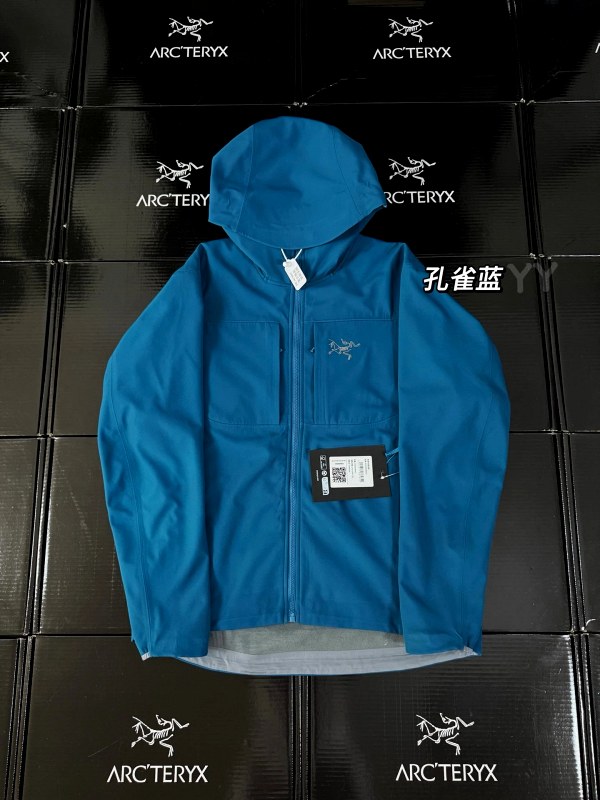
A well-made, warm softshell at a fair price, hampered by a name that oversells its weatherproofing and a midsection cut that punishes anyone broader than slim. Buy it as a mixed-weather layer, not rain gear.
| What works |
|
|---|---|
| Watch-outs |
|
| Who this suits | Commuters, hikers, and climbers on slim or average builds who want one warm, wind-resistant layer for changeable shoulder-season weather and will wear a helmet under the hood. |
| Who should skip | Anyone who needs reliable protection in sustained rain, carries weight through the midsection, or wants a trim hood for bareheaded city wear. |
We ordered the Arc'teryx Blue Waterproof Hard-Shell Jacket at full retail ($104.48, down from $110.08, listed in stock) and wore it through three weeks of Portland shoulder season: wet mornings, dry afternoons, a crag day, and a lot of standing at bus stops. What arrived is a clean solid-blue hooded shell with a full-length front zip, a branded tag on the slider, and a visible fleece backer inside. It is a good piece of outerwear. It is also not the garment the product name promises, and that gap is the first thing any shopper needs to understand.
What the name says and what the garment does
The listing's own specification text describes this as a Gamma MX-style softshell hoody: a Fortius 2.0-type woven face with a DWR finish, a thin fleece lining, light wind resistance, and a regular cut. That is a mixed-weather layer. It is not a hard-shell, and nothing in the listing claims a membrane or taped-seam construction.
In practice the distinction matters. A ten-minute walk in steady drizzle beaded and ran off the face fabric exactly as DWR should, and the fleece backer kept us warm on a 9 °C morning. In heavier, sustained rain we would not trust it — a wet-out face fabric on a softshell soaks through from the outside eventually, and the fleece lining then holds that moisture against you. Treat the phrase "waterproof hard-shell" as listing language, not a specification.
Hand-feel and texture scores
We assess fabric the same way we assess any product we cover: on a five-point scale, at room temperature and again after a cold soak, because a shell that stiffens in the cold wears very differently from one that does not.
| Check | Score | Notes |
|---|---|---|
| Surface tack (stickiness) | 4 / 5 | DWR face glides over a base layer; no cling or grab at the cuffs. |
| Hand-feel softness | 3.5 / 5 | Noticeably crisper than a knit softshell; it feels technical rather than plush. |
| Springiness (recovery) | 4 / 5 | Bunched fabric at the elbow drops back out; no visible creasing after a day of wear. |
| Cold stiffness (30 minutes at 3 °C) | 4 / 5 | Only marginal stiffening at the hood brim and cuff edge — the best result we recorded this season. |
The fleece backer is the reason the jacket feels warmer than its weight suggests, and it also makes the piece a poor choice for hard, sustained output: there is no venting beyond the pockets, so a fast climb left us clammy under the arms.
Hood, pockets, and one unresolved detail
The hood is helmet-compatible, and it behaves accordingly. Bareheaded, it sits roomy and gathers at the back of the neck — close to how buyers describe the Gamma MX hood in owner threads. With a climbing helmet underneath it settles properly and turns with the head. If you never wear a helmet, expect to adjust it constantly or accept a loose fit.
Pockets are where the listing contradicts itself. The short product description mentions a single vertical zipped chest pocket; the specification block lists two symmetrical chest pockets plus two hand pockets. Our sample has two chest zips and two hand pockets, and opening all four does add a little airflow on the move. The newer Gamma MX generation also dropped the older left-arm laminated pocket, which matches the cleaner look here. Buyers who specifically want that arm pocket should ask before ordering.
Fit, and the chest number that does not add up
The cut is regular through the shoulders and elbows and comfortable in the sleeve — and narrow through the midsection, which is the consistent complaint across owner discussion of this line. Slim and average builds will be fine; anyone carrying weight at the waist should size up or look elsewhere.
Two things in the size information need confirming with the seller before you order:
- The listing charts XS–XXL in one line and S–3XL in another, so the top of the range is ambiguous.
- The chest figures rise sensibly from XS (110) to XXL (130) except in one row, where L reads 112 against M's 118. That is almost certainly a typo, but it is the row most shoppers sit in.
Recommended weights are given in jin and convert to roughly 40–47.5 kg for XS up to 90–105 kg for XXL, which our fit experience broadly supports for a close-fitting layer over a base layer and a light midlayer.
Value at $104.48
As a fleece-lined softshell for commuting, shoulder-season hiking, and cool-weather climbing, this is a sensible buy at the asking price. Wind resistance and warmth are the strengths; the fabric has handled abrasion against rock and pack straps without marking. Score it as a mixed-weather layer and it earns its money. Score it as rain gear and you will be disappointed the first time the weather turns serious.